
Factories, power plants, and supply chains now run on connected machines that talk to corporate networks and the cloud. That shift unlocks efficiency, and it quietly rewrites the risk ledger for every industrial business.
Cyber incidents rank as the number one global business risk for 2026, the fifth year running, according to the Allianz Risk Barometer. For plants, the danger is no longer just stolen records. It is stalled production and unsafe equipment.
For business leaders, the first question is simple: what is OT security? This guide answers that, explains why it now sits in the boardroom rather than the engineering bay, and shows how it is reshaping the way leaders weigh industrial risk.
Key Takeaways
- OT security protects the machines and control systems that run physical industrial processes, not only digital data.
- Convergence has erased the old air gap, exposing plant systems to internet-borne threats.
- A breach that reaches the plant floor can halt output, damage machines, and endanger workers.
- Industrial incidents are costly, with plant-affecting breaches averaging above the global breach figure.
- Governance, segmentation, and monitoring now sit at the heart of industrial risk planning.
OT Security, Explained
OT security is the practice of protecting operational technology, the hardware and software that monitor and control physical equipment and industrial processes. It defends the systems behind factories, energy grids, water plants, and transport networks, where safety and uptime outrank everything else.
Think of the robotic arms on an assembly line, the pumps at a treatment facility, or the sensors along a pipeline. Each one now carries a digital footprint that an attacker could target.
Operational technology covers industrial control systems, supervisory control and data acquisition platforms, and the programmable logic controllers that run machinery. These tools were engineered decades ago for reliability, not for fending off modern attackers.
Unlike office computing, this equipment speaks proprietary protocols and frequently runs on legacy hardware that cannot be patched on a whim. Defending it calls for methods tuned to industrial reality.
OT Risk Versus IT Risk
The two domains share networks but rarely share priorities. One protects information and privacy. The other protects the continuous, safe operation of physical processes.
| Factor | IT risk | OT risk |
| Main goal | Protect data and privacy | Keep operations safe and running |
| Downtime impact | Lost productivity | Halted production and safety hazards |
| Patching | Frequent and routine | Rare and tightly controlled |
| Equipment lifespan | A few years | Often measured in decades |
| Worst case | Data breach | Physical damage or injury |
That gap shapes every decision, from how often you patch to how you react to an alert.
Why Industrial Risk Is Being Reshaped
For most of their history, plant systems sat behind an air gap, walled off from the outside world. Connectivity changed that for good in the pursuit of data, speed, and lower costs.
Now an email lure or a stolen password in the office can open a path straight to the production line. Federal guidance for protecting industrial control systems notes that the old isolation can no longer be assumed, so defense now leans on layered controls.
Attackers favor this route because plant systems were never designed to defend themselves. Many run software that has not been updated in years, and taking them offline to patch can be costly or unsafe.
“The convergence of IT and OT, driven by business demands, has created a sprawling, high-stakes attack surface.” IBM X-Force, 2025
Adopting connected technology is a balancing act, much like the choice between leading edge and bleeding edge. The reward is real, and so is the exposure when security lags behind the rollout.
The Business Risks of Weak OT Security
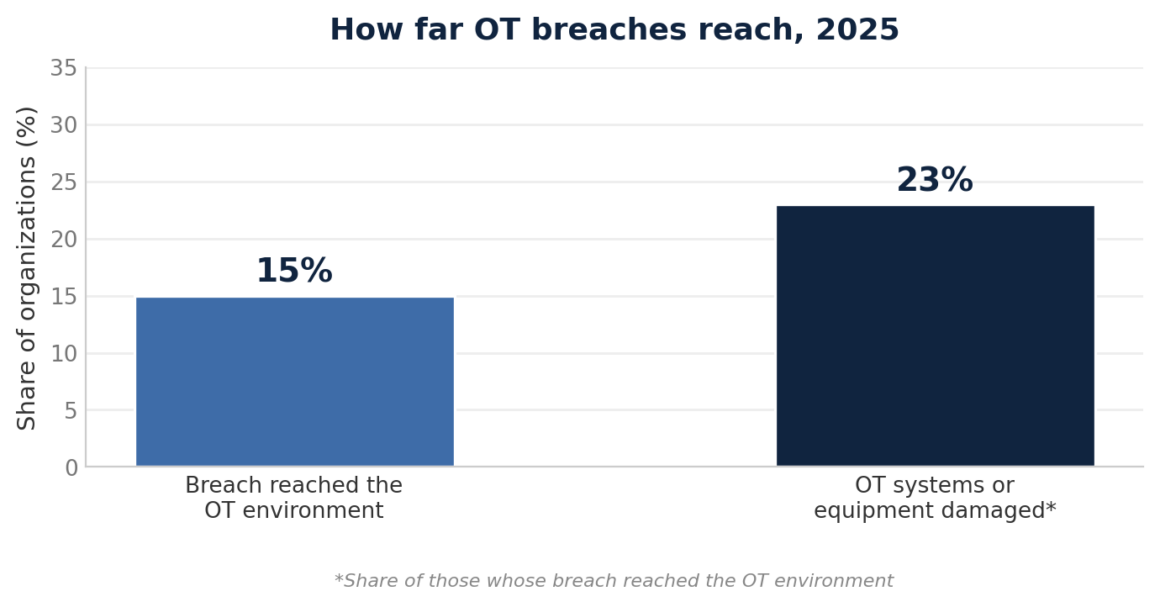
When plant systems fail, the bill lands across the whole company. Research shows how often the damage reaches that far: among organizations studied for a 2025 breach report, 15% had an incident affect their OT environment, and nearly a quarter of those suffered damage to systems or equipment.
The fallout tends to split into four connected categories.
Financial Loss and Downtime
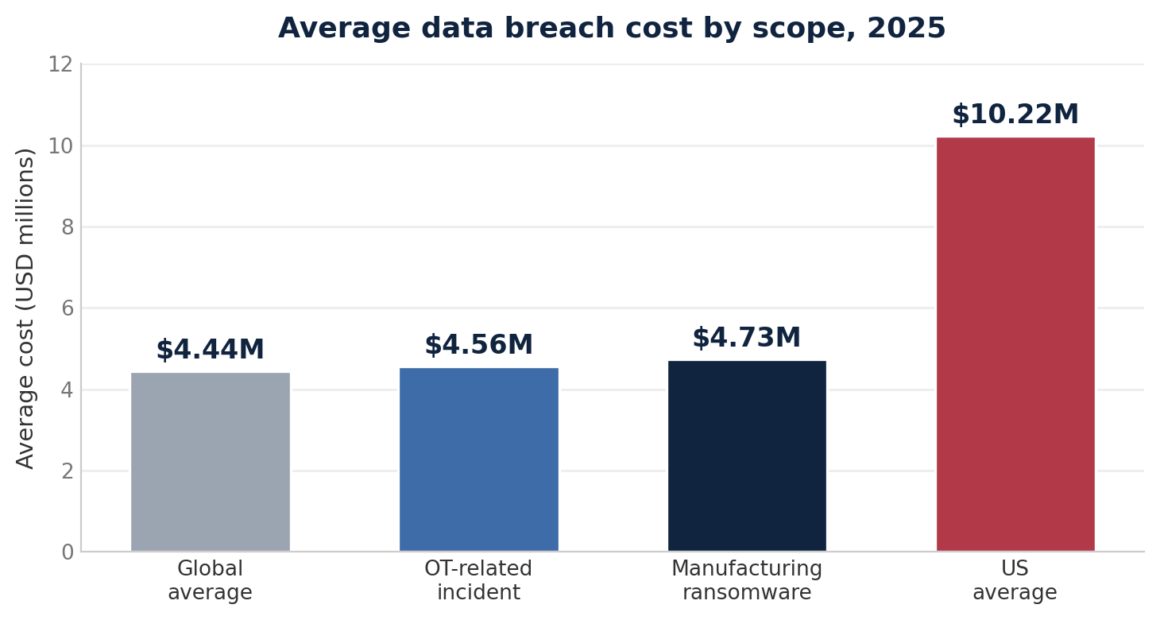
Industrial incidents hit hard. Breaches that reached OT environments cost an average of 4.56 million USD in 2025, above the global average of 4.44 million, according to IBM.
Manufacturing now draws more fire than any other sector, absorbing 17% of targeted ransomware attacks last year at roughly 4.73 million USD per hit.
The deepest pain is usually the stoppage. A 2022 ransomware attack on a parts supplier forced a one-day shutdown across 14 plants and affected about 13,000 vehicles. In 2025, a major steel producer paused output at several sites after an intrusion.
For any firm built on recurring revenue streams, even a brief outage can ripple through contracts, deliveries, and cash flow.
| Key stat: In the latest Allianz survey, a record 42% of leaders named cyber their single biggest worry for 2026, keeping it the top global threat for five years running. |
Safety and Physical Harm
OT failures can cross from the screen into the physical world. A manipulated controller can wreck machinery, trigger a chemical spill, or put the people on site in danger.
Recovery is rarely quick. Specialized parts, safety checks, and manual restarts can keep a damaged line idle long after the attacker is gone.
| Warning: This is the line that sets industrial risk apart. A data breach hurts the balance sheet, while a plant incident can hurt employees and the surrounding community. |
Regulatory and Compliance Exposure
Rules are tightening as critical infrastructure draws closer scrutiny. Falling short can bring fines, forced shutdowns, and a damaged license to operate.
Sound data security and compliance practices reduce that exposure, since regulators increasingly expect documented controls, incident reporting, and audit trails for connected systems.
New rules across energy, water, and transport now set baseline security duties and tight breach-reporting deadlines. Waiting for a mandate to act often means scrambling later under far more pressure.
Reputation and Supply-Chain Trust
Plants sit inside tight supplier networks. One breach can stall partners downstream and shake the confidence of customers who counted on steady delivery.
Ransomware accounted for 60% of the value of large cyber claims in the first half of 2025, a sign of how fast an incident can turn into a financial and reputational crisis.
Trust is hard to rebuild. Buyers who lose a shipment to an avoidable outage may quietly move their orders elsewhere.
How Industrial Businesses Are Responding
Leaders are treating plant security as core risk management. A handful of moves carry most of the weight.
First comes visibility, because you cannot protect equipment you have never mapped. Teams build a live inventory of every connected asset on the network.
Next comes segmentation, which stops a single problem from spreading across the site. Outside entry points get locked down too, since contractors and vendors are a frequent way in.
Purpose-built secure remote access for industrial operations grants least-privilege, time-boxed entry with full session records, rather than wide-open network tunnels.
Continuous monitoring and a rehearsed response plan round out the program. Worldwide security spending is rising to meet the moment, projected at 212 billion USD in 2025 by Gartner.
Above all, ownership has moved upstairs. Plant risk now sits with senior leaders who fund it, measure it, and report on it the way they handle any other major threat.
Frequently Asked Questions
What does OT security protect?
It safeguards the equipment and control software behind physical processes, including industrial control systems, monitoring platforms, and programmable logic controllers across factories, utilities, and transport networks. The goal is safe, continuous operation rather than data privacy alone.
How is it different from IT security?
IT security puts data confidentiality first, while plant security puts uptime and safety first. Industrial gear is also older and proprietary, so protective measures must avoid disrupting live processes that cannot easily be taken offline.
Why has the plant floor become a bigger business risk?
Linking once-isolated systems to enterprise networks and the internet removed the air gap. Attacks that start on the business network can now reach machinery, turning a digital incident into a production stoppage or a safety hazard.
What is the financial impact of a plant breach?
Incidents that disrupted OT environments cost about 4.56 million USD on average, higher than the worldwide figure, per IBM. Costs grow further when output halts, contracts slip, and recovery stretches across weeks of lost production.
Which industries face the most exposure?
Manufacturing, energy, utilities, transport, and water systems carry the heaviest burden. Manufacturing alone took the largest share of targeted ransomware campaigns in 2025, more than any other business sector.
How can a company start improving its defenses?
Begin with a complete asset inventory, then add segmentation, strict remote access, ongoing monitoring, and a tested response plan. Map each step to a recognized industrial standard so progress stays measurable.
Turning Awareness Into Action
Protecting the plant floor has moved from a niche engineering task to a defining factor in industrial risk. The connected facility brings efficiency, yet it also hands attackers a route into physical operations.
The companies that stay ahead treat this as part of strategy, fund it like any other major risk, and keep staying informed about emerging cyber threats on the leadership agenda.
Map your assets, separate your networks, control who gets in, and watch closely for trouble. The cost of preparation is small next to the price of a silent production line, and the gap only widens the longer it is ignored.