
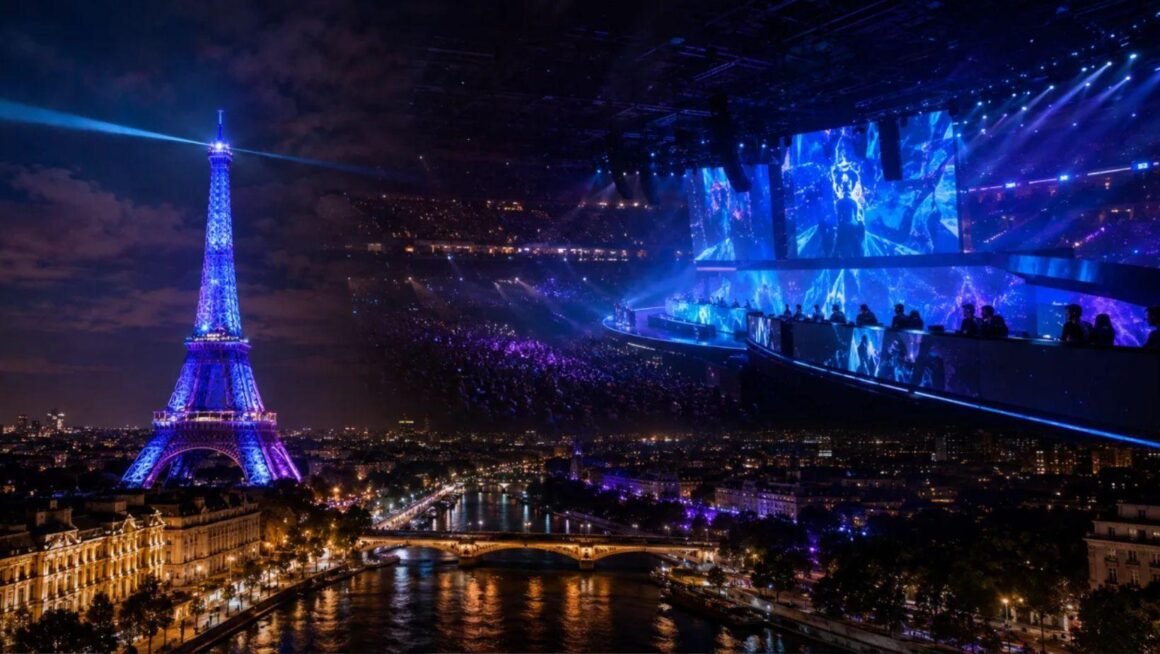
When the Esports Foundation announced in May 2026 that its flagship tournament was leaving Riyadh for Paris, the decision landed less like a scheduling adjustment and more like a business pivot with geopolitical undertones. Security pressures in the Middle East triggered the change, but the commercial logic behind choosing Paris was already compelling on its own terms. For a sport still working to establish itself as a permanent fixture on the global events calendar, moving the Esports World Cup to Europe’s most iconic event city sends a message that matters well beyond the venue.
Table of Contents
ToggleFrom Riyadh to the Rooftops of Paris: Why the Move Matters
The first two editions of the Esports World Cup were held in Riyadh’s Boulevard City, where Saudi Arabia’s Public Investment Fund committed significant backing to position the country as the world’s esports capital. That investment worked. The tournament became a credible global platform, pulling over 2,000 players from more than 100 countries and establishing a $75 million prize pool that dwarfs anything comparable in competitive gaming.
Paris steps in not as a temporary fix but as a statement of scale. The venue, Paris Expo Porte de Versailles, carries serious credentials: it hosted events during the 2024 Olympic and Paralympic Games and has been home to Paris Games Week for more than a decade. For platforms covering competitive gaming and the adjacent entertainment economy, including gamble gorilla and others tracking how major sporting events intersect with the iGaming market, the shift to a European host city opens up a structurally different audience and a new commercial conversation.
The Esports Foundation CEO Ralf Reichert met French President Emmanuel Macron at the Elysée Palace before the announcement, which signals the level at which national governments are now treating esports investment. This is not a niche gaming tournament being accommodated by a conference centre. It is a soft-power event backed at the highest political level.
A $75 Million Prize Pool and the Infrastructure Behind It
Seven weeks. Twenty-four games. Twenty-five tournaments. These numbers frame the sheer operational complexity of staging the Esports World Cup, which runs from 2 July to 23 August 2026. Paris Expo Porte de Versailles must simultaneously house competition arenas, broadcast operations, fan activation zones, and media facilities across an event that outlasts most major sporting championships.
The prize pool itself is a business instrument as much as a competitive incentive. At $75 million, it locks in publisher participation, keeps elite clubs committed to the Club Partner Program (each receiving $1 million in funding), and gives broadcasters a clear narrative to sell. The previous Riyadh editions are estimated to have generated around $600 million in economic activity for Saudi Arabia. French officials project Paris will see between €300 million and €600 million in direct and indirect impact, figures that reflect the ambitious expectations placed on the tournament as a driver of tourism and hospitality spending across the French capital.
For event organisers, the broadcast scheduling shift to European time zones is also commercially meaningful. European and North American audiences, who have historically watched Saudi-based tournaments on awkward local times, now get prime-time access. That increases ad rates, streaming engagement, and sponsor visibility across the markets where most of the world’s consumer esports brands are headquartered.
Paris Bets on Becoming Europe’s Esports Capital
The context for Paris’s ambitions is a market growing fast enough to justify the ambition. According to Mordor Intelligence, the global esports market stands at $5.34 billion in 2026 and is forecast to reach $6.78 billion by 2031, with betting and fantasy platforms among the fastest-growing revenue streams within the ecosystem. The BLAST.tv Paris Major, a single Counter-Strike tournament held in the city in 2023, generated an estimated $32.4 million in economic benefit for Paris. Hosting the full Esports World Cup is a different order of magnitude.
The French capital’s ability to combine established event infrastructure, international transport links, and a politically engaged local government creates a template that other European cities will study closely. Paris has positioned itself not as a one-off host filling an emergency vacancy, but as a recurring candidate for global esports events. With 100,000 tickets sold ahead of the opening week, the audience appetite appears to validate that positioning.
What the Esports World Cup does particularly well as a business model is broaden participation beyond any single title or publisher. The multi-game format pulls fans of shooters, MOBAs, battle royales, and fighting games into the same physical and digital space. That cross-genre audience is commercially attractive to sponsors and media partners who want reach across the full spectrum of competitive gaming, rather than the narrower fanbase attached to any single esport.
The Betting Angle: Esports Wagering Goes Mainstream
One of the more consequential business trends running alongside the growth of live esports events is the parallel expansion of esports betting. According to data from European Gaming, esports betting grew 16% year-on-year among major European operators in 2024, making it the fastest-growing gambling product after bingo, and that trajectory was established before the EWC moved to a European timezone.
The mechanics are straightforward: a high-profile esports tournament on European soil, streaming in prime time across the continent, raises awareness of competitive gaming among audiences who are also active online sports bettors. Sportsbooks across the UK and Europe have steadily added esports markets over the past three years, moving from niche tabs buried in the sports lobby to prominently featured sections with match odds, map betting, and in-play options. The EWC’s format, which features titles like League of Legends, Counter-Strike 2, and Call of Duty across successive weekends, creates a near-continuous betting calendar throughout the summer.
For the iGaming industry, the EWC’s Paris move is not just interesting as a piece of sports business news. It is a concrete expansion of the audience and context in which esports wagering products are relevant. A European host city, European broadcast times, and European ticket buyers all point toward a summer in which the esports betting market gets a meaningful commercial push in exactly the markets where online gambling platforms are most active.
The business story of Paris 2026 is ultimately about a sport that started as a niche community and is now being managed, hosted, and capitalised on at the level of any traditional major sporting event. The organisations involved, from the Esports Foundation to the French government to the iGaming operators tracking EWC markets, are all treating it that way.